How to Set Up Attendance Policies for Startups in India 2025 Sample Policy, Best Practices, and How OxHRM Makes It Easy
Why Attendance Policies Matter for Startups
For Indian startups, attendance is more than just “whoʼs here”—itʼs about productivity, payroll accuracy, compliance, and culture. Without clear rules, confusion, disputes, and payroll errors can arise. A well-designed attendance policy sets expectations, reduces friction, and helps HR manage payroll and leave smoothly.
In 2025, with remote, hybrid, and onsite teams, attendance policies must be flexible, fair, and enforceable. Modern HRMS tools like OxHRM make it easy to set up, communicate, and automate attendance rules for any work model.
Key Elements of a Startup Attendance Policy
A strong attendance policy should cover:
- Working Hours: Define standard office hours, start/end times, and weekly offs.
- Grace Periods: Specify how late an employee can be without penalty.
- Breaks: State break durations and rules.
- Remote/Hybrid Rules: Clarify attendance expectations for WFH or hybrid employees.
- Overtime: Define when overtime applies and how itʼs tracked.
- Absences: Explain what counts as an unauthorized absence and the process for reporting leaves.
- Leave Types: Reference the leave policy for different types of absence.
- Attendance Tracking Method: Specify how attendance is recorded (manual, biometric, mobile, etc.).
- Penalties: Outline consequences for repeated absenteeism or late arrivals.
Sample Attendance Policy for Startups India 2025
You can adapt this as a template for your startup:
1. Purpose
This policy defines expectations for employee attendance and punctuality.
2. Working Hours
- Standard working hours: 900 AM 600 PM (Monday to Friday)
- Weekly off: Saturday and Sunday
3. Grace Period
- Late arrival up to 15 minutes will not be counted as late.
- Late arrival beyond 15 minutes will be recorded and may impact payroll or attendance records.
4. Breaks
- Lunch break: 1 hour (1:00 PM 2:00 PM)
- Short breaks: Two 10-minute breaks per day
5. Remote/Hybrid Work
- Employees working remotely must be available during core hours 1000 AM 500 PM.
- Attendance will be tracked via mobile app or web portal.
6. Overtime
- Overtime will be approved by managers and tracked in the HRMS.
- Overtime pay will be calculated as per company policy.
7. Absences
- All absences must be reported to the manager and HR in advance, except for emergencies.
- Unauthorized absence will be marked as a loss of pay.
8. Leave Types
- Refer to the companyʼs leave policy for details on leave entitlements.
9. Attendance Tracking Method
- Attendance will be tracked via OxHRM (mobile app, web, or biometric device).
10. Penalties
- Repeated absenteeism or late arrivals may result in a written warning, performance review, or other disciplinary action.
Best Practices for Attendance Policy Implementation
- Communicate Clearly: Share the policy with all employees and get written acknowledgment.
- Be Fair: Apply rules consistently across all teams and roles.
- Be Flexible: Allow for genuine emergencies and personal issues.
- Track Accurately: Use a reliable attendance system to record and report attendance.
- Review Regularly: Update the policy as your team and work model evolve.
How OxHRM Simplifies Attendance Policy Management
OxHRM helps startups implement and enforce attendance policies with ease:
- Flexible Tracking: Supports multiple methods (mobile, web, biometric, QR, GPS) for onsite, remote, and hybrid teams.
- Automated Rules: Configurable grace periods, overtime, and absence rules ensure consistent enforcement.
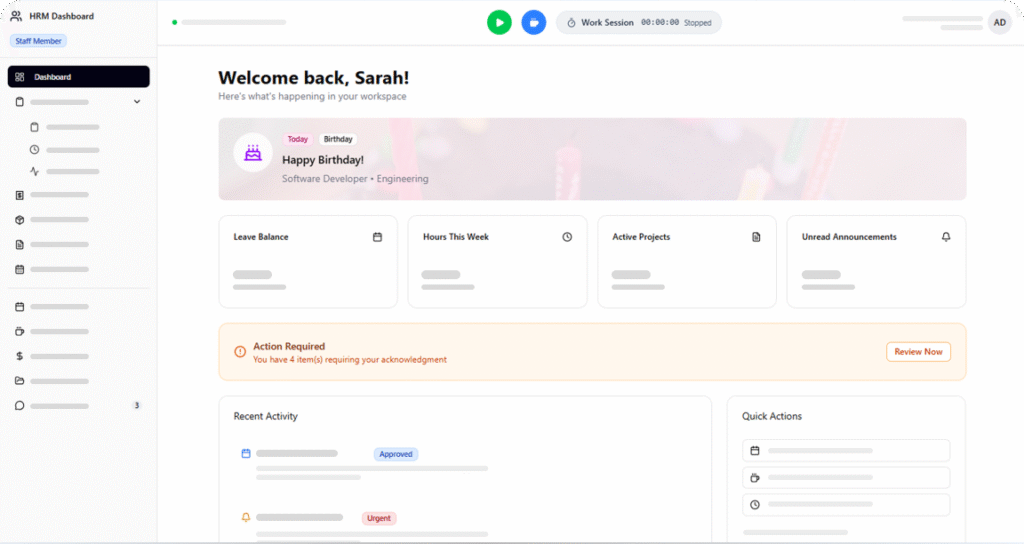
- Real-Time Dashboards: Managers and HR can view attendance status, late arrivals, and absences instantly.
- Self-Service: Employees can view their attendance records, apply for leave, and track approvals.
- Compliance: Maintains accurate, auditable attendance records for payroll and statutory compliance.
- Policy Integration: The attendance policy can be published in the digital HR handbook, with employee acknowledgments tracked in the system.
Turning Attendance Policy into a Lead Magnet
From this article, you can create a downloadable “Attendance Policy Template for Startups India 2025” as a Word or PDF document. Gate it with a simple form Name, Email, Company, Employee Count) and brand it as “Powered by OxHRM”.
Conclusion: Build a Fair, Flexible, and Enforceable Attendance Policy
A clear attendance policy is essential for any startup in India. It sets expectations, reduces disputes, and ensures payroll accuracy. By combining a well-written policy with a modern HRMS like OxHRM, you can automate tracking, enforce rules fairly, and adapt as your team grows.
If youʼre ready to move from manual attendance to a digital, compliant system, explore how OxHRM can help.
Book a demo or start a free trial of OxHRM today, and make attendance management easy for your startup.
Table of Contents

Shafeeq Khan is a web developer who creates modern, responsive, and user-friendly websites with clean code and creative design
Latest Posts
10 Payroll Problems Killing Indian Startups (And HRMS Fixes That Work)
Problem 1: PF/ESI Registration Delays Issue: Startups hit 10+ employees but delay PF/ESI registration. Penalty: 25% interest + fines up...


Multi-State Payroll Calculator for Indian Startups (2026 Edition)
Why Every Startup Needs This Tool Indian startups now operate across states Jaipur HQ hires from Kota, remote workers from...

PF/ESI Audit Preparation Checklist for Indian Startups 2026
Why PF/ESI Audits Are Coming for You 2026 Reality: Labour inspectors now target startups with 10+ employees. Random audits, employee...