How to Write a Fair Employee Monitoring & Time Tracking Policy for Remote Teams in India 2026
Why You Need a Written Monitoring Policy in 2026
Remote and hybrid work have made digital monitoring (time tracking, screenshots, app usage, AI analytics) common, but without a clear policy, it can damage trust and morale. In 2026, Indian and global companies increasingly combine monitoring tools with explicit, accessible policies that explain what is tracked, why, and how it will be used, to balance transparency, compliance, and productivity expectations.
A written employee monitoring & time tracking policy helps:
- Protect employee privacy and dignity while using tracking tools.
- Reduce fear and rumors around “surveillance” by clearly defining scope and limits.
- Give HR and managers a defensible framework in case of disputes or legal scrutiny.
Core Principles of a Fair Monitoring Policy
Before drafting clauses, define the principles you stand on:
- Transparency: Employees must know exactly what is tracked (time, apps, screenshots), when, and for what purpose.
- Proportionality: Only collect the minimum data required to meet legitimate business needs (e.g., billing, security, compliance).
- Access Control: Limit raw screenshot or detailed activity log access to specific roles (e.g., HR, compliance) and only when necessary.
- Employee Visibility: Allow employees to see their own data; modern monitoring tools that do this report higher trust and fewer disputes.
- Outcome Focus: Emphasize that data is primarily for planning, improvement, and fair workload—not a tool for micromanaging every minute.
These principles align with best-practice guidance in recent discussions on ethical monitoring and AI in HR.
Sections to Include in Your Policy With Sample Language Ideas)
You can structure your policy as follows and turn it into a downloadable template/lead magnet.
1. Purpose and Scope
Explain why monitoring exists and who it applies to.
- Example: “This policy describes how the company uses digital tools to record working time, activity, and project efforts for remote, hybrid, and office-based employees. It applies to all full-time, part-time, and contractual staff using company systems.”
2. What We Monitor
Specify data types clearly:
- Working time (login/logout, active/idle periods).
- Applications/websites used during work hours.
- Screenshots at defined intervals (e.g., every X minutes).
- Project/task tags associated with time entries.
Clarity on data types and intervals reduces ambiguity that often creates resistance.
3. When Monitoring Occurs
Define monitoring windows:
- Only during scheduled working hours (including agreed flexible bands).
- No monitoring outside work hours, during approved breaks, or when time is explicitly marked as personal.
Many tools now allow excluding breaks and after-hours activity, which is considered a best practice for privacy.
4. How Data Is Used
Explain acceptable uses:
- Verifying timesheets and project billing.
- Planning capacity, identifying overload/underuse.
- Investigating suspected policy or security breaches (with due process).
- Aggregated analytics for productivity and process improvement AI dashboards, trend reports).
Also explicitly state what it is not used for, such as spying on private life or punishing minor deviations, which research shows is important for trust.
5. Who Can Access Monitoring Data
Detail access controls:
- Individual employees can view their own time logs and screenshots.
- Managers can see aggregated or task-level data for their teams.
- HR/compliance may access more detailed history only in specific, documented scenarios (e.g., investigations).
Limiting visibility is a key recommendation in monitoring software best practices.
6. Data Retention and Security
Include:
- How long screenshots/activity logs are kept (e.g., 3 12 months).
- How data is stored (encrypted, access logged).
- When and how data is deleted or anonymized.
This lines up with global data protection expectations that increasingly influence Indian companies.
7. Employee Rights and Escalation
Clarify:
- Right to ask what data is held about them.
- Right to request correction of inaccurate time logs.
- Channel to raise concerns or complaints about misuse HR, ombuds, or POSH/ethics committee).
Ethical AI & monitoring guidance stresses clear recourse for employees.
8. Consent and Acknowledgment
Explain that:
- Using company systems and the time-tracking app implies consent under this policy.
- Employees must digitally acknowledge the policy (e-sign or in HRMS.
Digital acknowledgment is standard in modern HRMS setups for policies.
How OxHRM Can Operationalize This Policy Positioning Angle)
You can connect this policy article to OxHRMʼs capabilities without turning the piece into a hard sell:
- Policy Hosting & Acknowledgment: Host the monitoring policy inside OxHRMʼs HR handbook and track which employees have accepted it.
- Configurable Monitoring: Use OxHRMʼs desktop time tracking with configurable screenshot intervals, idle thresholds, and exclusions (e.g., breaks).
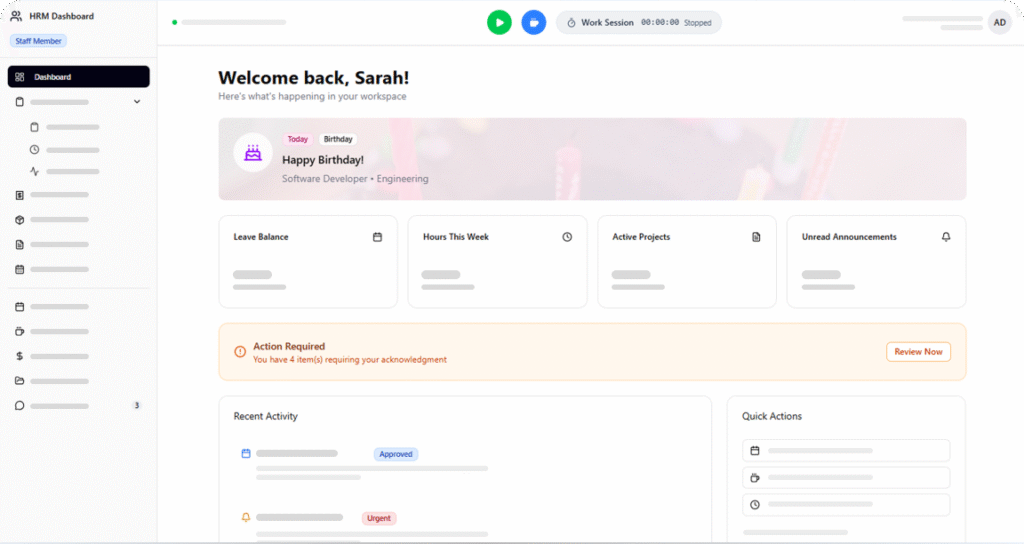
- Employee Dashboards: Give each employee access to their own time and screenshot history to encourage self-correction and transparency.
- AI Analytics on Top of Policy-Compliant Data: Use AI dashboards for utilization, burnout risk, and capacity planning—while respecting the boundaries defined in the policy.
This links your advanced features (time tracking, screenshots, AI, project analytics) to a responsible implementation story, which is exactly where the HR conversation is heading for 2026.
If youʼd like, the next article can be a downloadable “Employee Monitoring & Time Tracking Policy Template for Indian Startups 2026” written in full legal/policy language, ready to plug into your site as a lead magnet.
Table of Contents

Shafeeq Khan is a web developer who creates modern, responsive, and user-friendly websites with clean code and creative design
Latest Posts

10 Payroll Problems Killing Indian Startups (And HRMS Fixes That Work)
Problem 1: PF/ESI Registration Delays Issue: Startups hit 10+ employees but delay PF/ESI registration. Penalty: 25% interest + fines up...



Multi-State Payroll Calculator for Indian Startups (2026 Edition)
Why Every Startup Needs This Tool Indian startups now operate across states Jaipur HQ hires from Kota, remote workers from...

PF/ESI Audit Preparation Checklist for Indian Startups 2026
Why PF/ESI Audits Are Coming for You 2026 Reality: Labour inspectors now target startups with 10+ employees. Random audits, employee...