How to Reduce Employee Absenteeism: Practical Strategies, Sample Policy, and How OxHRM Helps
Why Absenteeism Is a Silent Profit Killer
Employee absenteeism doesnʼt always show up as one big problem—it leaks into productivity, project delays, overtime costs, and burnout among those who cover for absent colleagues. For growing businesses and startups, frequent unplanned leave or late arrivals can quietly increase costs, hurt client confidence, and strain internal teams. The good news is that absenteeism is one of the most controllable HR issues—once you have visibility, a clear policy, and the right tools to support fair enforcement.
Step 1: Understand the Real Causes of Absenteeism
Before changing policies, you need to understand why people are absent. Common reasons include unclear expectations, stressful workloads, poor work-life balance, health issues, disengagement, or even lack of proper attendance systems. HR teams that rely only on gut feeling risk misdiagnosing the problem. The first step is to measure: track who is absent, how often, on which days, and in which teams. Patterns often reveal if the root is managerial, cultural, or personal.
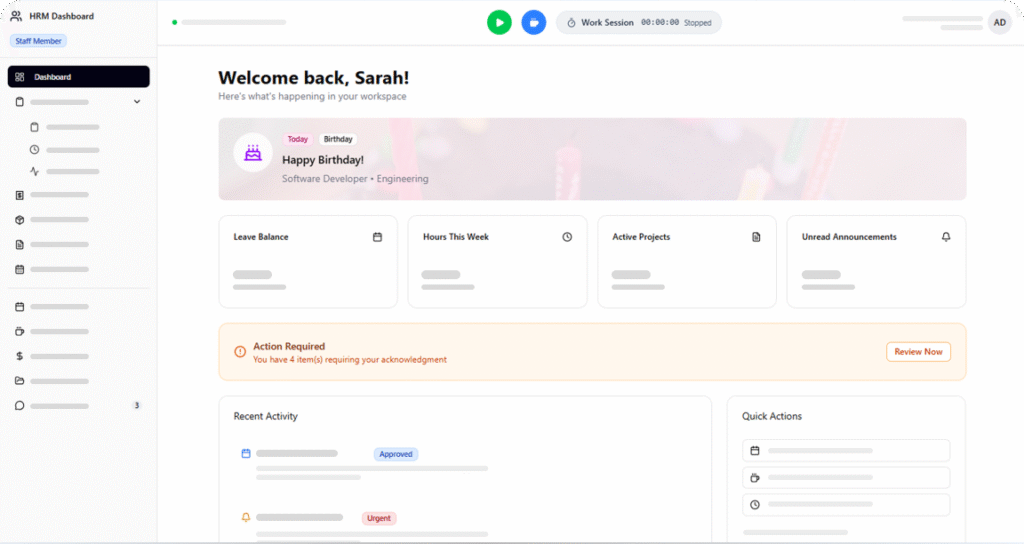
With OxHRMʼs attendance insights, HR can view absence trends by department, day of week, shift, or branch. That clarity turns absenteeism from a vague frustration into a specific, solvable problem.
Step 2: Create a Clear, Written Absenteeism & Attendance Policy
Many companies informally “expect” people to show up but never define the rules. A proper attendance and absenteeism policy should:
- Define working hours, grace periods, and late rules
- Clarify types of leave (casual, sick, earned, unpaid)
- Explain what counts as unauthorized absence
- Outline reporting procedures (whom to inform, by when, via what channel)
- Describe consequences for repeated issues (warnings, performance impact, etc.)
When employees can read and reference expectations, theyʼre less likely to violate them unintentionally. OxHRM allows you to publish this policy in your digital HR handbook and get employee acknowledgments, so everyone is aligned from day one.
Step 3: Improve Visibility With Accurate, Easy Attendance Tracking
You canʼt manage what you donʼt measure. If attendance is still tracked on paper or via manual spreadsheets, errors and disputes are inevitable. A modern, digital system reduces friction and resistance. OxHRM supports multiple methods—web, mobile, GPS, IP, QR, or biometric-based clock-in depending on your work model. Employees find it easy to mark their presence, and managers can see real-time status.
Reliable tracking reduces “grey areas” where some employees exploit loopholes. It also makes it easier to differentiate genuine issues from patterns of misuse.
Step 4: Make Leave Policies Fair, Flexible, and Transparent
Absenteeism often spikes when employees feel they must “fake” sickness because genuine leave is hard to get or socially discouraged. A fair leave policy that allows for planned time off, sick days, and emergencies—paired with simple approval flows—reduces unnecessary unplanned absence.
In OxHRM, employees can see their leave balances, apply in a few clicks, and track approvals. Managers get enough context to plan workloads. This transparency builds trust and gives people permission to rest when needed, instead of vanishing without communication.
Step 5: Talk Early With Repeat Offenders—Not Just Once a Year
Waiting until appraisal time to raise attendance issues almost guarantees defensiveness and resentment. Instead, managers should have early, calm one-on-one conversations as soon as a pattern emerges. The goal is not punishment but understanding and resolution:
- Is the person struggling with commute, childcare, or health?
- Are there workload or conflict issues with the team?
- Can flexible hours, remote options, or schedule changes help?
OxHRMʼs reports help managers enter these discussions with facts instead of assumptions.
Step 6: Strengthen Engagement and Work Culture
Disengaged employees are far more likely to take frequent uninformed leave. If people donʼt feel connected to the companyʼs goals, leaders, or peers, absence feels low consequence. Reducing absenteeism isnʼt only about strict rules—itʼs also about building an environment where employees want to show up.
Regular communication, recognition, fair growth opportunities, and manager support all reduce absenteeism. OxHRMʼs communication hub and company wall make it easier to celebrate wins, share updates, and increase connection across locations.
Step 7: Offer Flexibility Where Possible
Rigid “one-size-fits-all” working hours often clash with real-life responsibilities, especially in urban India with long commutes or in roles that can be done remotely. Where business allows, flexible timings, hybrid schedules, or compressed workweeks can significantly reduce stress driven absences.
Using OxHRM, HR can configure different shifts, flexible schedules, and remote work tracking so flexibility doesnʼt damage visibility or payroll accuracy.
Step 8: Use Escalations and Consequences Consistently
While empathy and support come first, some absenteeism is driven by lack of accountability. Your policy should define:
- Thresholds for concern (e.g., X instances per month/quarter)
- Stages: verbal reminder, written warning, performance impact, HR escalation
- How absenteeism affects bonuses, promotions, or confirmations
Consistency is crucial: if rules only apply to some people, attendance will deteriorate. With OxHRM, HR has access to objective logs and can apply policy fairly based on data, not favoritism or guesswork.
Step 9: Analyze Trends and Act at the System Level
Sometimes absenteeism isnʼt a “bad employee” problem; itʼs a “bad system” problem. For example:
- One department has far higher absenteeism than others (possibly due to a difficult manager or unrealistic workload).
- Absences spike before/after major deadlines (indicating burnout).
- Certain shifts or locations suffer more (indicating commute or safety issues).
OxHRMʼs analytics help you see these patterns and discuss systemic fixes: staffing changes, training for managers, schedule adjustments, or well-being initiatives. Data transforms absenteeism conversations from blame to problem-solving.
Sample Absenteeism & Attendance Policy Outline You Can Adapt)
You can use the structure below as the base for an HR policy template or lead magnet:
Purpose & Scope
- Why the policy exists
- Who it applies to (all employees, specific categories, etc.)
Working Hours & Attendance Expectations
- Standard working hours and breaks
- Remote/hybrid rules, if applicable
Types of Leave
- Casual, sick, earned, unpaid, special leave definitions
- Eligibility and approval requirements
Reporting Absence
- Whom to inform, how (phone/email/portal), and by when
- Emergency situations and documentation (e.g., medical certificates)
Late Coming & Early Leaving
- Grace periods, impact on pay, and escalation rules
Unauthorized Absenteeism
- Definition and examples
- Consequences for repeated violations
Recording & Verification
- Systems used (e.g., OxHRM attendance, mobile punch-in)
- How corrections or disputes should be raised
Roles & Responsibilities
- Employee responsibilities
- Manager responsibilities
- HR responsibilities
Disciplinary Procedure
- Stages of warnings and escalation path
Exceptions & Special Cases
- Festival periods, natural disasters, or public health emergencies
You can plug this outline into a downloadable “Absenteeism & Attendance Policy Template” and capture leads from HR managers and startup founders.
How OxHRM Helps You Reduce Absenteeism End-to-End
OxHRM supports every stage of your absenteeism control strategy:
- Accurate tracking: Multi-mode attendance (web, mobile, GPS, QR, IP) with real-time dashboards.
- Clear policies: Digital HR handbook and policy acknowledgment within the platform.
- Self-service leave: Employees apply, track, and understand balances without HR intervention.
- Automated alerts: Notifications for late logins, missed punches, or unapproved absences.
- Analytics: Trend reports by team, location, or time period help you act early.
- Engagement: Communication tools foster culture and connection, reducing disengagement driven absence.
Conclusion: Turn Absenteeism from a Problem into a Performance Lever
Absenteeism will never vanish completely—but unmanaged absenteeism is expensive and avoidable. With clear policies, empathetic management, flexible but accountable systems, and strong analytics, you can drastically lower its impact on your business.
OxHRM gives you the digital foundation to do all of this: measure reliably, communicate clearly, enforce fairly, and improve continuously.
If youʼre ready to turn attendance from a monthly headache into a predictable, well-managed process, explore how OxHRM can support your HR team and managers.
Book a demo or start a free trial of OxHRM today—and take the first step toward a more present, engaged, and productive workforce.
Table of Contents

Shafeeq Khan is a web developer who creates modern, responsive, and user-friendly websites with clean code and creative design
Latest Posts
10 Payroll Problems Killing Indian Startups (And HRMS Fixes That Work)
Problem 1: PF/ESI Registration Delays Issue: Startups hit 10+ employees but delay PF/ESI registration. Penalty: 25% interest + fines up...


Multi-State Payroll Calculator for Indian Startups (2026 Edition)
Why Every Startup Needs This Tool Indian startups now operate across states Jaipur HQ hires from Kota, remote workers from...

PF/ESI Audit Preparation Checklist for Indian Startups 2026
Why PF/ESI Audits Are Coming for You 2026 Reality: Labour inspectors now target startups with 10+ employees. Random audits, employee...